WEEK 8 : Hand Delivery Made Simple – Building Reliable, Confident Retrieves
 Sue Watkins
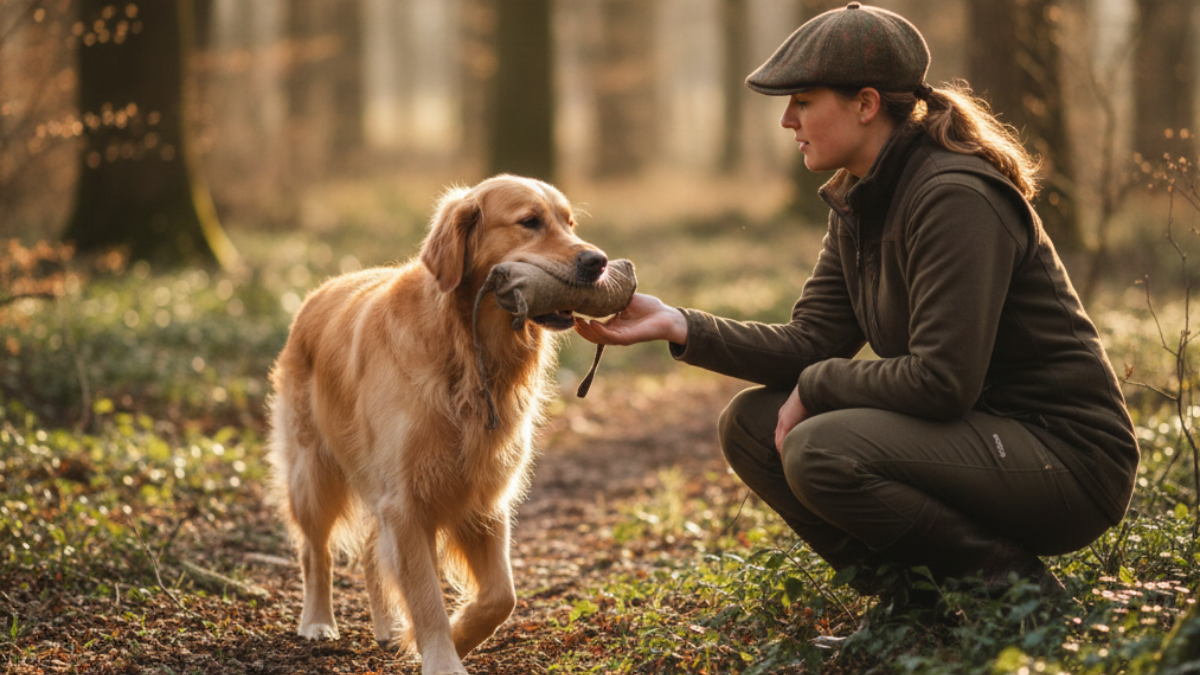
This week, we’re diving into three of my favourite positive-reinforcement methods for developing beautiful deliveries
WEEK 8
Hand Delivery Made Simple – Building Reliable, Confident Retrieves
Hand delivery is one of those behaviours that looks effortless when it’s polished… but in reality, it’s a carefully constructed chain of skills. A calm, tidy delivery doesn’t just happen. It’s built through thoughtful training, clear communication, and a dog who feels confident in every stage of the retrieve.
This week, we’re diving into three of my favourite positive-reinforcement methods for developing beautiful deliveries:
-
Clicker retrieve
-
Reverse luring
-
Tidying toys into a box
Each of these builds clarity, self-control, and accuracy — without pressure, force, or conflict. Most importantly, they help your dog want to bring items back to you and hold them calmly until asked to release.
Why Hand Delivery Matters
For gundogs, delivery isn’t simply the end of the retrieve — it’s the point at which teamwork truly shows. A reliable, controlled delivery supports:
-
A soft, confident mouth
-
Reduced mouthing or chewing
-
Confidence and certainty in the task
-
Prevention of dropping, parading, or avoiding the handler
-
A strong partnership based on communication, not conflict
It’s important to emphasise: we do not train dogs to drop the retrieve into the handler’s hand.
Instead, the dog is trained to bring the dummy or bird to the handler and co-hold it until a clear release cue is given. This moment of shared holding:
-
Prevents premature dropping
-
Reduces risk of damage
-
Builds emotional calmness at a highly excited stage
-
Strengthens teamwork and communication
Hand delivery is not one skill. It is the result of many smaller behaviours working together in harmony.
1. Clicker Retrieve – Clear, Logical, Dog-Led Learning
The clicker retrieve is perfect for dogs who need clarity or confidence in their delivery.
Breaking the retrieve into tiny steps helps the dog understand each part of the chain.
Step-by-step:
-
Mark interest – click for looking at or sniffing the article.
-
Mark contact – click when the dog touches or lifts it.
-
Build hold duration – mark calmness and steadiness, not frantic gripping.
-
Add movement – encourage the dog to take a step or two towards you while holding.
-
Introduce co-holding – reward when the dog brings the item to you and both of you hold it together until your release cue.
By reinforcing each step, the dog learns that calm, deliberate behaviour earns the reward — not rushed or panicked actions.
2. Reverse Luring – Teaching Calmness Through Choice
Reverse luring is one of the most effective tools for teaching dogs self-control during delivery.
Many dogs get excited as they approach:
-
Chomping or repositioning the item
-
Dropping it early
-
Charging past the handler
Reverse luring helps them understand that holding calmly is what earns reinforcement.
Your method: flat, open-hand choice
I use reverse luring with the treat held in a flat, open hand, not a closed fist.
This is important because:
-
It gives the dog clear visual information
-
Removes frustration from a closed hand
-
Lets the dog actively choose to take the reward
-
Encourages voluntary self-control
The dog quickly learns:
🟦 If I hold the item calmly, I earn the reward.
🟦 If I fuss or drop it, the reward is delayed.
This approach strengthens calmness and focus, and transfers directly into co-holding during hand delivery.
3. Tidying Toys – The Fun Foundation
Tidying toys may look simple, but it’s an excellent precursor to delivering a dummy or bird.
By asking the dog to place toys gently into a box, you teach:
-
Accuracy
-
Soft mouth control
-
Returning to a target (your hand or co-holding position)
-
Calm dropping, on cue
It’s a low-pressure game that builds confidence and focus. When transitioning to real retrieves, the dog already understands how to handle objects calmly and deliberately.
Bringing the Skills Together
Once the components are solid — picking up, holding, moving towards you, and co-holding — you can link them into a smooth, confident delivery.
A dog trained this way will:
-
Approach the retrieve with confidence
-
Carry it with a soft, steady mouth
-
Return directly to the handler
-
Co-hold calmly until a release cue is given
-
Maintain focus and composure at the moment of delivery
What looks like one effortless behaviour is actually many small successes stacked together.
Final Thoughts
Hand delivery is one of the most rewarding parts of gundog training. By using methods that support your dog’s emotional state — clarity, choice, and calmness — you create a delivery that is reliable, safe, and enjoyable.
Take your time. Celebrate each small step. And remember: work with the dog you have in front of you, not the one you had yesterday or the one you think you should have.
Your gundog is learning — and so are you.